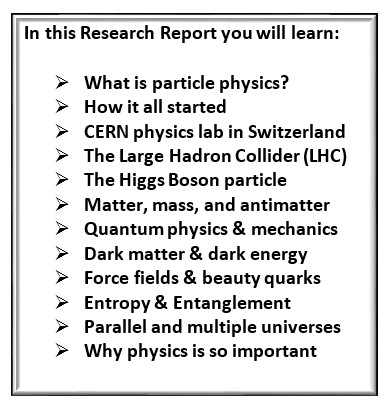
Here is a suggested way to use this report as a learning tool about the universe around us:
1. Go to the end and read the hashtags. Note how many terms you understand.
2. Now go to the Intermezzo and watch the Hadron Rap Song as often as you like.
3. Continue reading below. Explore as many of the links as you can. This paper basically links you to accessible readings and videos on aspects of the world of atoms.
4. Use your search engine to read up on any term you don’t understand.
5. This Research Report is in PDF format. You can Open it to insert links that you like.
6. Enjoy the Hadron Rap Song again when you reach the Intermezzo. It will make more sense.
7. Pay particular attention to the brilliant and entertaining lecture on The Standard Model by young physicist Harry Cliff at the Royal Institution in Westminster, England. It’s a long one but ties everything together.
8. Now review the hashtags again and see how many important terms in particle physics you understand.
9. If you are in middle school or high school, consider a career of lifelong fascination in the amazing world of science … just a bunch of STEM classes and you are on your way!
Going back in time …
The first test of the upgraded giant linear accelerator machine called the Large Hadron Collider (LHC) occurred in September, 2010 at CERN, the European Organization for Nuclear Research (Centre Européen de Recherches Nucléaires in French). It’s in a suburb near Geneva, Switzerland. The test was supposed to be just a short one to see if everything worked after a significant upgrade. The LHC was powered up for the test run to aim two sub-atomic particle beams to collide head-on at 7 TeV (trillion electron volts). Initial tests failed spectacularly, largely due to highly-powerful magnets that happened to be designed and built in the U.S.
How do I know this? The massive LHC machine located at CERN was down for months. This gave your author, along with co-worker and former career physicist John Celi at the StorageWorks Division of Digital Equipment Corporation (DEC) in Shrewsbury, Massachusetts, the opportunity to visit the world’s largest physics experimental device in Geneva, Switzerland, during in the early 90s and learn a little about the fascinating field of particle physics.
In the beginning …
Where did the idea of infinitesimal atoms, the building blocks of matter, begin? Over 2,000 years ago Greek philosophers Democritus and Leucippus theorized about atomos … atoms. The smallest particles possible. Over time these theories evolved until we have a fairly good idea of what is everything. The story in this paper picks up in the 1990s. But if you want to go back to the beginning, check out this YouTube video if you have a spare 43 minutes to follow the history of the atom up through the exciting race between America’s Fermilab in Illinois and Europe’s CERN in Switzerland.
More images
Back in Business
The Large Hadron Collider (LHC) went back online in March, 2010. At that point it became the world’s largest operational particle collider, also called a particle accelerator. This was just 56 years after the original opening ceremony of the giant worldwide atom-smashing agency CERN in 1956 where the workers who built the huge collider depicted pre-Christian Druidic beliefs in that region of Europe.
The LHC was the result of a $9 billion investment and years of collaboration from member states worldwide. It promised to unlock great mysteries that lay inside the atom and deeper insights into how antimatter behaves.
The launch had its share of disappointments. First, researchers were alarmed by death threats from fearful observers who worried the device would generate huge black holes. This, despite reassurance from the world’s top scientists that any tiny black holes that did arise during operation of the LHC apparatus would quickly evaporate. Second, at the last moment before the LHC was turned on for its test run, it was ominously stated that the LHC was experiencing some small electrical problems. This would be enough to set the whole earth back almost 400 billion years … oh, wait, the earth is only some 4.54 billion years old. Scratch that last point.
None of these issues could put a damper on the launch though. CERN scientists were on a launch roll and it continued on schedule. The giant atom smasher/cyclotron/particle collider/accelerator was switched on at 9:30 AM CEST (Geneva time) and at 9:49 AM the first beam of protons was fired through the first 3-km of the 27-km circular ring. It took 48 seconds to generate the pulse.
Basically, everything worked just as it was engineered. Firing of protons ramped up, and by 10:25 AM the proton beam was travelling the entire track … leaving Geneva, then leaving Switzerland and entering France, then returning to Geneva to complete the loop. The tests went quicker and had fewer issues than expected. Counterclockwise beams were then tested successfully.
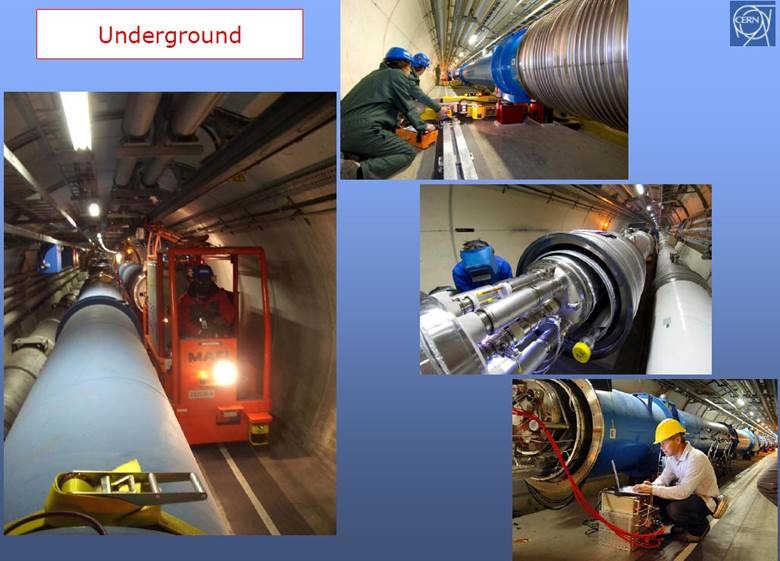
When protons were sent in opposite directions from a point in the circular path in Geneva at CERN headquarters, they would smash into each other halfway around the track, where the huge Atlas detector apparatus was installed to read the action of all the particles that collide and record the results. Of the eight detectors, two are designed for general purpose experimentation: the ATLAS experiment and the Compact Muon Solenoid (CMS).

CERN expected the LHC with its eight detectors to be fully operational and begin unlocking the mysteries yet to be discovered inside the atom within a few months based on the strong initial testing. After the counterclockwise tests, the next step was to perform the first atom-smashing procedure later in the month, colliding two beams of speeding protons together. How do they do it you ask? Why it’s by magic my boy the Music Man would answer. But in this case, it’s with magnets … lots of very powerful magnets (not to be confused with trombones) that pull the beam of protons down the circular track … faster and faster towards the collision point. Now the experiments are rolling and results forthcoming.
Data accumulated from detector readings is massive. CERN’s Data Centre handles about one petabyte of data per day.
Advanced reading: Recently, physicists from Mexico and Poland discovered new evidence of the fascinating world inside the proton that involved the physics concepts of entropy and quantum entanglement.
What’s coming next at CERN?
Experiments at the world’s largest particle accelerator that’s unlocking our understanding of the internal works of the atom as well as the make-up of the universe? Well, a bigger and badder cyclotron than the LCH is coming … the Future Circular Collider (FCC). It will be way more powerful than the LHC and push the boundaries of particle physics further to deepen our understanding of the structure of matter and the structure and origin of the universe. By 2050 the FCC could be smashing atomic particles with approximately six times the force (100 TeVs) of today’s LHC. Pics and videos. And always a CERN newsletter.
Although confirmation of the Higgs Boson at CERN significantly contributed to completing the Standard Model for physics, it’s only a part of a bigger picture that includes new physics hidden deep in the subatomic world and even in the dark recesses of the universe. Perhaps new experiments with the LHC and its successor, the FCC, will help us to discover more of the missing pieces.
Back to the business of particle physics … refill your coffee … let’s review.
0. Two kinds of physics. The physics that operates at a visible level that we all can see is called Newtonian Physics after Sir. Isaac Newton who sat under that apple tree and pioneered its laws including Newton’s Law of Universal Gravitation (the old “what goes up must come down” rule). The physics that operates inside the atoms is entirely different. It is called quantum physics or the more specific quantum mechanics … not much difference for us lay people, but the realm of quantum science brings a huge potential for the world. Right up there with Artificial Intelligence (AI) … both good fields to consider for any aspiring college science student.
1. Sub-atomic particles. The way to find out what is in an atom is to smash its parts together at very high speeds … and then discover what comes out that you still don’t know about atoms.
2. The atom. The atom’s basic parts are protons and neutrons in the center (nucleus) and electrons whizzing around in orbits (called electron shells) that surround the atom’s nucleus.
3. Quantum physics/quantum mechanics. Only the protons and neutrons can be smashed into each other. When they do collide, their behavior is governed by the strange and counter-intuitive world of quantum physics made popular in the book Alice in Quantumland.
4. Cyclotrons and colliders we know and love. A cyclotron is a huge doughnut-shaped tube surrounded by dipole magnets to propel various atomic particles at high speeds. Basically, it’s a linear accelerator that’s been bent into a circle. The huge cyclotron in Geneva, Switzerland reaches across the border into France. It is 20+ miles in diameter and belongs to CERN, the atomic energy agency that initially served 20 European countries. Now, any country can be a member of CERN and support them. The U.S. joined in 1997. The U.S. originally had its particle physics primarily done at the Linear Accelerator at Berkeley, California, and still operates Fermilab in Batavia, Illinois. Here’s a list of particle physics labs around the world and other cool stuff.
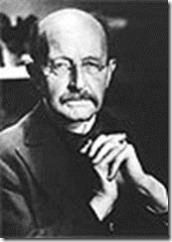 ‘A scientist is happy, not in resting on his attainments but in the steady acquisition of fresh knowledge.’
Max Planck
(1858-1947)
Nobel Prize, physics, 1947.
5. LHC. CERN finished building this cyclotron in 2008, called Large Hadron Collider (LHC), to send protons whizzing around the circular track at speeds that will approach the speed of light. It was upgraded in 2012, 2015 and will be augmented by a much larger collider called the Future Circular Collider (FCC). Some of the tiniest and most elusive particles are known as neutrinos. They were discovered (don’t miss the video in the middle of this link) for the first time in a collider during the test run of a new detector just installed at the LHC.
6. Collision course. To smash a sub-atomic particle (proton or neutron), you send a stream of them in opposite directions speeding around the cyclotron pathway accelerating faster and faster. Some of them will smash into each other in head-on collisions at a predetermined point on the track where a large underground detector structure many stories high is located. More from Physics Girl Dianna Cowern.
7. Collision point. At the collision point, the colliding protons or neutrons smash into each other and break into their smaller components and fly off in all directions.
8. Collision detectors. The collisions occur inside the part of the cyclotron’s circular track where the detector is located. Sophisticated components inside the detector can track the paths of the small parts that fly off … recording their trajectory, speed, and life before they decay.

9. Quarks. Up quarks and down quarks, along with electrons, are the only particles that make up protons and neutrons in the atom’s nucleus. And then of course, there’s always Quark TV. Other fascinating forms of quarks are being discovered.
10. Higgs Boson (labeled God particle). One very elusive particle had been predicted by many physicists but never detected in experiments. It’s called the Higgs Boson particle, so important the press quickly dubbed it the God particle (capital G for controversy). The Higgs Boson particle is the only particle within an atom that gives it weight, or mass. So, our weight is determined by the number of Higgs Boson particles in our body. Four leading particle physicists took a fascinating look at the frontier of particle physics and the role of the Higgs Boson particle.
11. Higgs Boson significance.
Perhaps the biggest discovery at the Large Hadron Collider at CERN is the confirmation of the Higgs Boson.
First, it’s significant because it supplies weight to the atom. As a result, it is the basis for the mass of the atom, and by extension, to the entire universe. And that is a very big deal to physicists.
Second, it’s significant because it completes the Standard Model of Particle Physics, as we know it today. It wraps up an important part of physics that underlies all matter in the universe, as explained in considerable depth by famous young physicist Harry Cliff in these lectures at the Royal Institution of Great Britain in the City of Westminster. His lectures cover in greater depth what is contained in this Research Report, along with his humor and excellent slides.
Third, the search for a missing particle for almost 50 years deserved to be not only recognized but celebrated. Moreover, the 50-year timeline of the Higgs Boson may have started in the 5th century with the postulating of the atom. CERN has its own page that elegantly illustrates the Standard Model; the equivalent of the Periodic Table of Elements for sub-atomic particles and force fields. Physicist David Tong provides this excellent and entertaining description of quantum or force fields, first postulated by Michael Faraday in 1846 at Great Britain’s The Royal Institution where Tong is lecturing.
Physicist Brian Hart reports:
“The Large Hadron Collider or LHC for short, is the largest most massive physics experiment that has ever been built in the history of man. That is why it is so significant.
If initial experiments are successful, it should smash two protons — the positively charged particles in the center of an atom — together with such force, that an extremely hot gas will be created, called the Quark-Gluon Plasma or QGP for short. If everything goes as anticipated, the QGP should match the material that is theorized to have pervaded the entire Universe back .000000000001 second after the Big Bang, when all the matter in it was roughly 10,000,000,000,000 degrees F.”
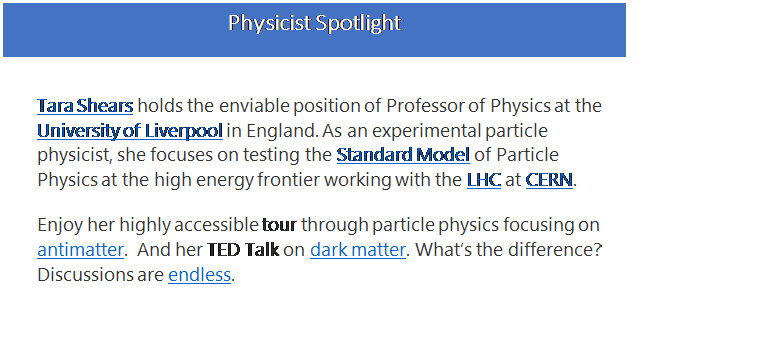 Recently, the LHC was reported involved in experiments that confirmed the non-existence of ghosts and references the Arrow of Time, and also Entropy, which is the tendency of things to run down and become disordered in the universe. The concept of Entropy has an interesting history.
The experiments on the new Large Hadron Collider at CERN’s facility in Geneva were viewed as the potential dawning of a new understanding of how matter is put together … an extension of what lies beyond the Standard Model. This is akin to what we have learned about interstellar structures from the Hubble Telescope, and are beginning to learn to a far greater extent from the newest James Webb Space Telescope.
Now grab that coffee and sit back to watch as four leading particle physicists at the 2019 World Science Festival take a fascinating look at the frontier of their field and the role of the Higgs Boson particle.
12. The Future Circular Collider (FCC). The LHC will eventually be replaced by the Future Circular Collider called the FCC. It will be ready by around 2040 and will continue the discoveries of the most basic building blocks of our universe.
The FCC design will be a larger cyclotron located in the same geographic area as the LHC but with much bigger measurements: a 100-kilometer (62.1 miles) circular track, diameter of 31.8 km (19.8 mi.) and power levels up to 100 TeV. Magnetic field is rated at 16 Tesla, double the 8 Tesla magnetic forces that drive particles around the HLC track. The FCC is part of a master development plan for particle physics experiments. FCC will be looking at matter-antimatter asymmetry and neutrino masses that are outside the current Standard Model of Particle Physics. And even the creation of the universe using the Big Bank Theory.
13. Accomplishments in Physics in 2021. Much was achieved this past year in labs like CERN, and Fermilab, and around the world. Some of the findings, like the experiments at the cyclotron at Fermilab in USA with Neutrinos and the Muon particle have profound implications. In March, a possible new force in nature may have been discovered. 2022 could be a breakthrough year for particle physicists … everyone is watching.
Afterward
When John Celi and I arrived back at DEC StorageWorks in Massachusetts in 1992, he turned to me as we walked off the plane and said, “Who knew physics could be so fascinating.” This summed up my unique introduction to particle physics.
The LHC at CERN is credited with proving, through experimentation, important aspects of particle physics that had been predicted. This includes the Higgs Boson, antimatter, dark matter and dark energy. Dark matter may have finally been viewed.
Future breakthroughs on the LHC and FCC might result in the discovery of new forces and contact with a parallel universe. Did you know there’s a big difference between a parallel universe (just two) and multiple universes (multiverse/omniverse)?
For more on the forces of nature that hold the particles in the Standard Model together, and a summary of much we have covered here, grab your coffee and watch fascinating lecture on forces.
* * * * *
If this Research Paper has piqued your interest, there are lots of great science publications to check out:
ü Science World …. easy and fun reading about science stuff.
ü Top 10 English language science magazines around the world.
ü Lots of cool science books.
The social type? You can learn more about particle physics groups, or join one, by going here.
Are you enamored with the LHC? You can download your own LHC wallpaper here.
Are younger members of your family interested in science? Maybe they would like to see what Sponge Bob has to say about particle physics. Or how about Physics for Kids ?
Extra credit: Award yourself a round of doughnuts and another cup of coffee, if you found all the hotlinks and viewed them.
Hopefully, a review of our hashtags will conjure up new mental images in your mind about the amazing universe around us. Do these terms make more sense? Can you talk to your friends about them?
* * * * *
About this Report
Contributor: Dennis A. Fletcher — Reporter, researcher, and community activist. Focus: News you can use. Beats: science, health, disaster preparedness, local events, senior citizens, homelessness.
Education: AA – Languages (German), Pasadena City College; BS – Industrial Marketing, Cal Poly Pomona University (honors); MBA, Cal State Los Angeles University (honors).
Author Credentials: California Community College Teaching Credential. Published five IT textbooks. Secretary, Hemet Library Foundation. Secretary, Human Relations Council for Hemet, San Jacinto, and Menifee. Member, Advisory Council for San Jacinto Senior Center. Former Community Affairs Reporter, The Valley Chronicle. Official Fact Finder, Baja News. Reporter for The Hemet Beat and Hemet Eye News.
Research: This Research Report is provided through the Research Department of Fletcher Marketing Services and The Hemet Beat. Reports focus on clarifying complex issues for the public. They shine a spotlight on careers in science, which can be best attained by taking STEM courses in school.
Research Reports available or in development:
COVID-19 Variants Including Delta & Omicron – Dennis A. Fletcher – Available (ongoing updates)
COVID-19 High School Lesson Plan – Gena Estrin – Available
Particle Physics for Kids – Dennis A. Fletcher – Beta version available (ongoing updates)
COVID-19 Protection Strategies – developing
COVID-19 Symptom Checklist – developing
Developments in Astronomy/Cosmology – developing
Developments in Seismology – planning
Developments in Biology – developing
All reports will be located at – www.FletcherMarketing.com (in development).
Word count: 3,669 Content links: 212 Flesch-Kinkaid Grade Level: 10.2
Printed pages: 14 Hashtags: 32

 Business Topics & Grants


Leave a comment